What you get back
- An English transcript next to the original Turkish transcript, plus a timestamped version.
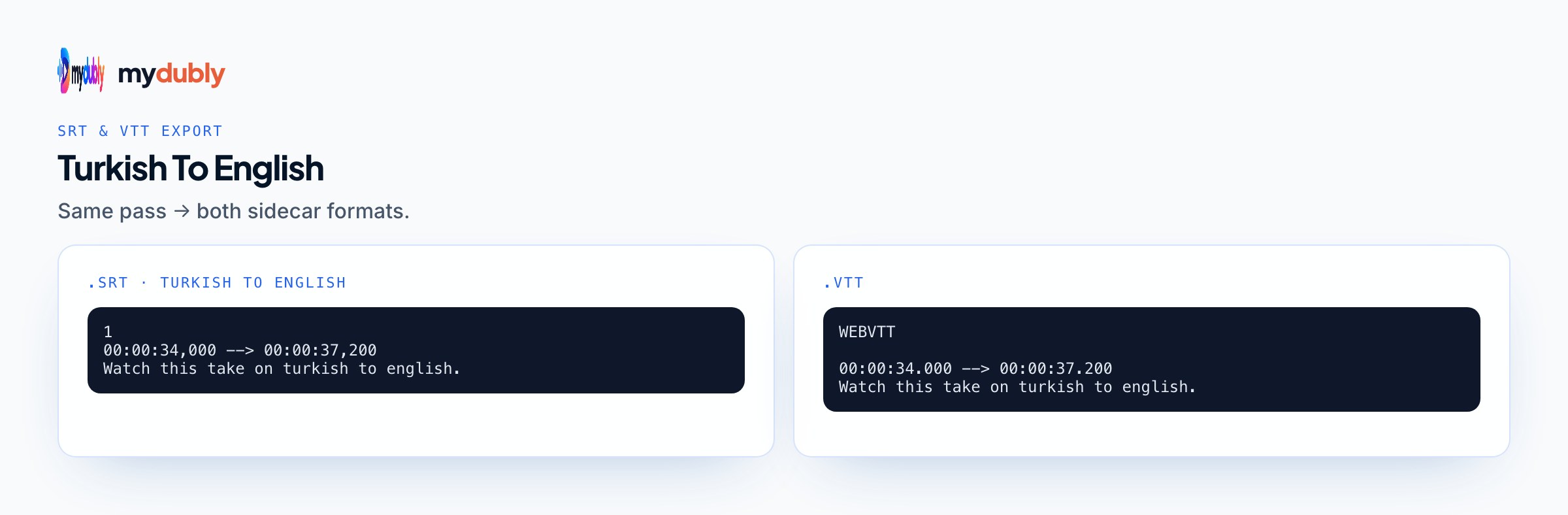
- English subtitles as SRT and VTT files.
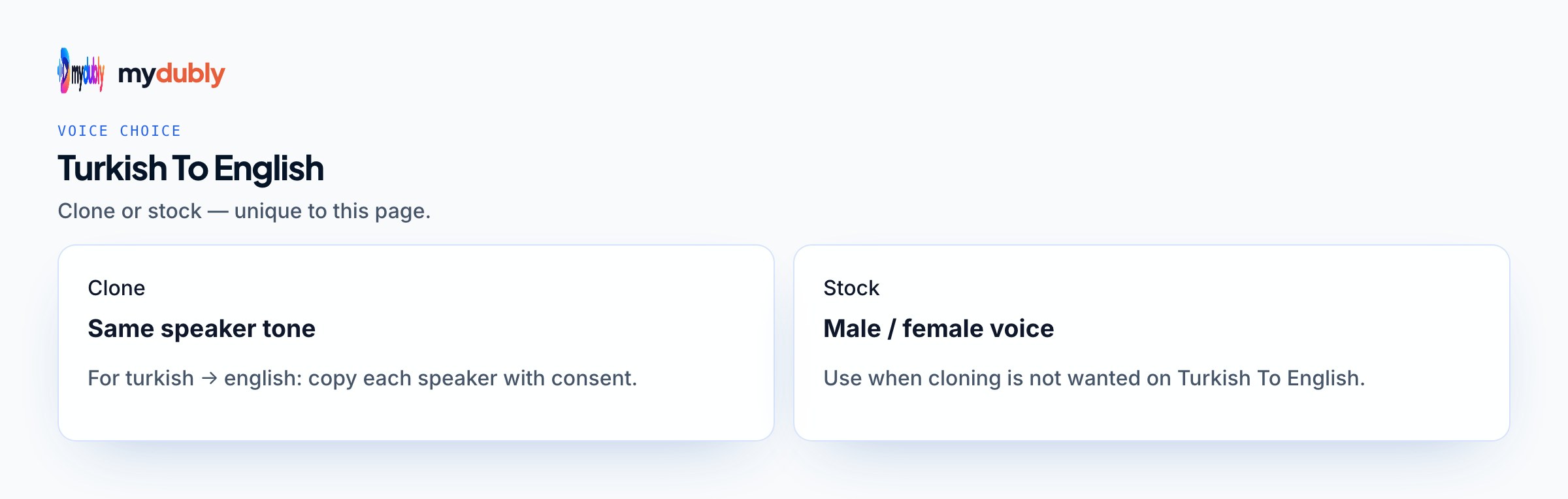
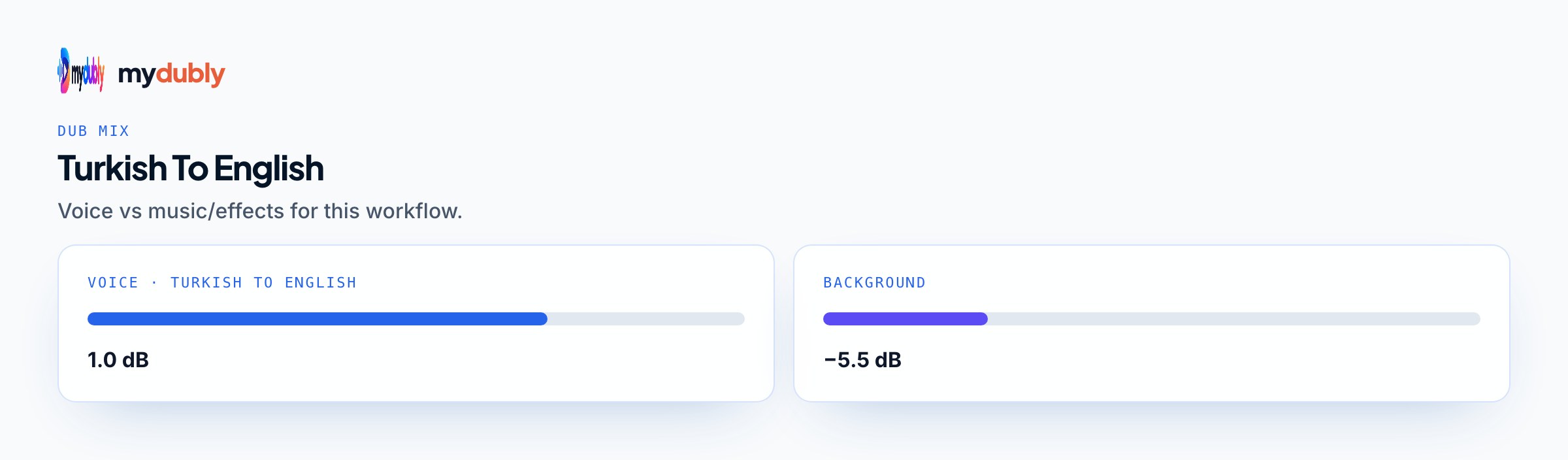
- With Full translation output on: an English voice track in which each person (up to 8) speaks in a copy of their own voice, the translated audio as M4A, and an MP4 that keeps your original picture, music and effects.
- Turkish is detected automatically. The tool above is already set to English, so you only drop in the file.
Turkish to English at a glance
Turkish to English rebuilds sentences from suffixes — one Turkish word can be a whole English clause. Turkish's phonetic spelling gives speech recognition a clean start.
Turkish video to English, suffix by suffix
Turkish builds meaning by adding suffixes to a root in a fixed order, so a single spoken word often needs a phrase in English. "Gelemeyeceğim" is "I won't be able to come"; "evlerimizden" is "from our houses"; "yapabilir misiniz?" is "could you do it?". Translating Turkish video to English therefore means unpacking words into several, and the English version of a short Turkish sentence usually has more words than the original.
The order changes as well. Turkish puts the verb last, and the verb carries tense, person and negation, so the facts that matter most ("did", "didn't", "will", "might") arrive at the very end. English needs them near the start. That is why the translation works on whole sentences, and why in a dub the English voice can state an outcome before the Turkish speaker visibly reaches it. Sentence-level dubbing explains how each translated sentence is timed against the original.
One syllable between yes and no
Negation sits inside the verb. "Geldi" is "came" and "gelmedi" is "didn't come"; "biliyorum" is "I know" and "bilmiyorum" is "I don't know". Clear speech transcribes these reliably, but in fast, mumbled or noisy passages a missed syllable flips the meaning, and the English then states the opposite without any sign of doubt. For instructions, agreements and quotes, compare positive and negative verbs in the English with the Turkish transcript.
-miş: what the speaker heard rather than saw
Turkish grammar marks whether the speaker witnessed something. "Gitti" means "he went" and the speaker knows it; "gitmiş" means "apparently he went", "I heard he went" or "it turns out he went". English has no grammar for this, so the translation has to add a word such as "apparently" or lose the nuance. In news footage, research interviews and testimony the difference matters: a rumour and a first-hand account read the same in English once the hedge is gone. Look for -miş, -mış, -muş and -müş forms in key passages of the Turkish transcript and check that the English keeps the distance. The research interview transcription page covers checking translated quotes in a study.
Sen, siz, Bey, Hanım and Hocam
Siz is both the polite and the plural "you", and sen the familiar one; English flattens both. Titles follow the first name: "Ahmet Bey", "Ayşe Hanım". A literal "Mr. Ahmet" sounds odd in English, and "Mr. Yılmaz" needs a surname the speaker may never say. Hocam ("my teacher") is used for teachers, academics and often any respected colleague, and abi and abla ("big brother", "big sister") for older friends, neighbours and shopkeepers. Decide whether to keep these words in English subtitles, which viewers who know Turkey often like, or to replace them with names.
Courtesy phrases with no English twin
Everyday Turkish is full of set phrases tied to a situation. "Kolay gelsin" (roughly "may it come easy") is said to someone at work; "geçmiş olsun" is said after an illness or any mishap; "ellerinize sağlık" ("health to your hands") thanks a cook; "inşallah" and "maşallah" turn up in secular conversation too. Translation picks an English phrase that fits the moment ("take care", "get well soon", "that was delicious") or drops the line. For travel, food and family content, check that the English sounds like something a person would say.
Dotted and dotless i in names
Turkish has a dotted and a dotless i, each with its own capital: i and İ, ı and I. Işık, İlker, Ilgaz and Çağrı are written differently from what an English keyboard produces. The English subtitles may keep the Turkish letters or flatten them; choose one and match how each person writes their own name. The subtitle files are UTF-8, so ç, ğ, ı, İ and ş display correctly in current players. If you combine them with older Turkish subtitle files saved in Windows-1254, the free SRT encoding converter re-saves those as UTF-8.
The English voice reads names by English rules, which Turkish spelling doesn't follow. C sounds like the j in "jam" (Cem), ç like "ch", ş like "sh", and ğ lengthens the vowel before it instead of sounding like a g (Doğan). Listen to the names in a short dubbed clip first; why AI voices mispronounce names shows how to tell a transcript error from a pronunciation error.
Buçuk, lira and dates
Turkish writes 2,5 for two and a half and separates thousands with dots. In speech, buçuk means "and a half": "iki buçuk milyon" is 2.5 million, and "saat üç buçuk" is half past three. Prices in lira (TL or ₺) stay in lira, and dates come day first, often with dots (09.10.2026 is 9 October). Compare prices, quantities and dates in the English with the Turkish transcript before you publish.
Reading speed in English subtitles
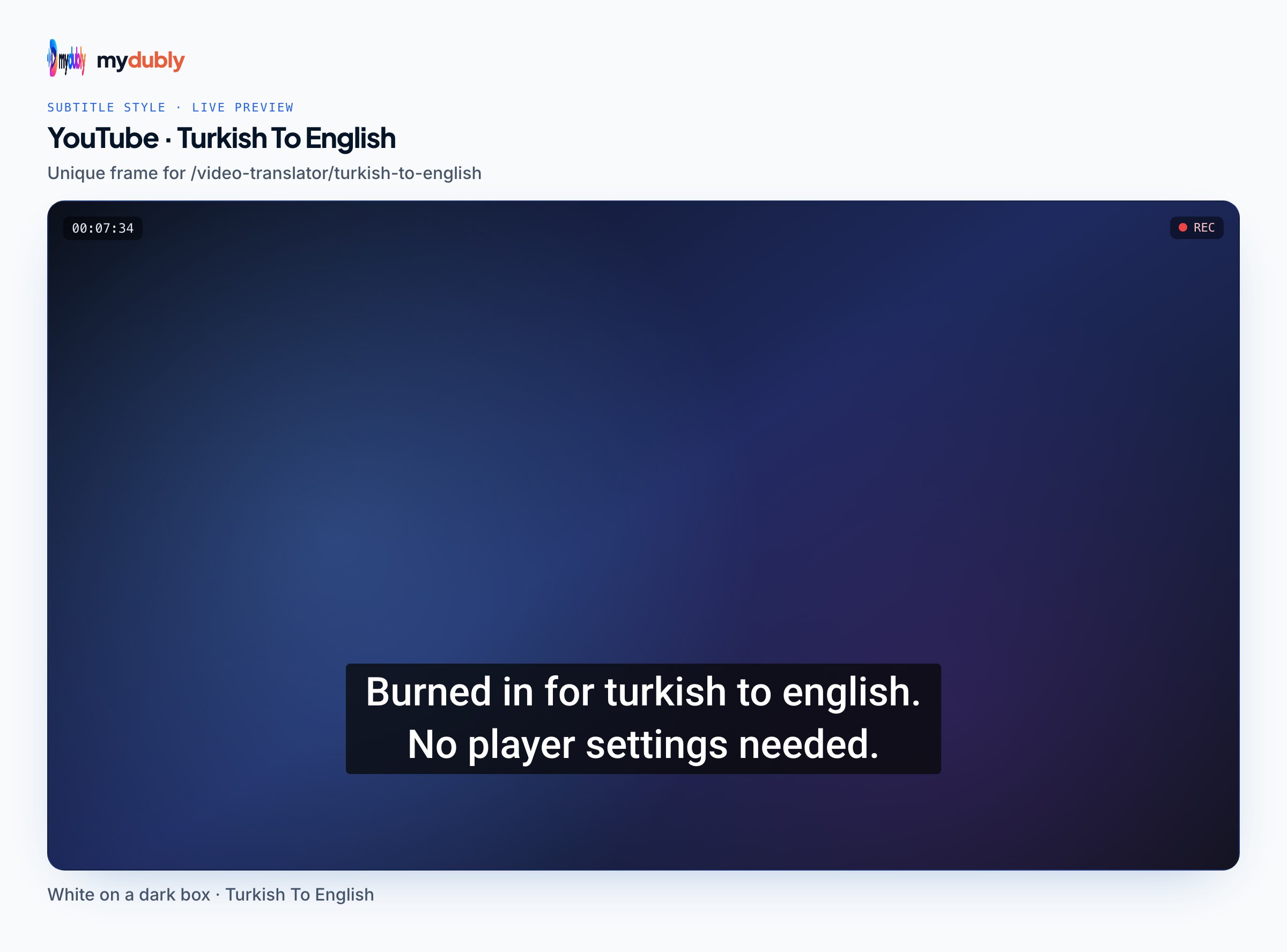
Because one Turkish word can unpack into four or five English ones, quick Turkish speech in talk shows, vlogs and football commentary can produce English cues that are too long to read in the time they are on screen. Open the English SRT with the video in the free subtitle editor, which warns about cues above 21 characters per second and lines over 42 characters. Shorten the wording rather than stretching cues across the next piece of dialogue; subtitle timing guidelines explain why.
Who translates Turkish video into English
- Exporters and manufacturers
- Factory tours, product demos and installation videos for buyers in Europe, the UK and the US
- Universities
- Lectures, defences and events in Turkish shared with exchange students and partner institutions
- Researchers and journalists
- Interviews with Turkish speakers in Turkey and in communities in Germany, the Netherlands and Austria
- Creators
- Turkish food, travel and gaming channels adding English subtitles or an English dub
Speakers who move between Turkish and German or English mid-sentence are covered in translating mixed-language videos.
Limits for Turkish sources
- Azerbaijani and Kurdish aren't among the 21 supported languages, even though Azerbaijani is closely related to Turkish; expect an unreliable transcript from either.
- Text on screen, such as news tickers, slides and burned-in Turkish subtitles, stays in Turkish.
- In a dub, each person (up to 8) speaks in a copy of their own voice; on panel shows where guests interrupt each other, a short line can land in the wrong voice.
- There is no lip-sync; the English is timed sentence by sentence, not to mouth movements.
Costed examples
A textile exporter in Denizli dubs an 11-minute Turkish factory tour into English for buyers in the UK.
Cost: 1,320 credits ($1.32) for the English dub, which includes the subtitles and both transcripts, or 55 credits (5.5¢) for English subtitles and transcripts without a voice.
A migration researcher in Amsterdam turns a 52-minute Turkish interview with a former guest worker into an English transcript, checking every -miş form against the Turkish.
Cost: 6,240 credits ($6.24) for the English dub, which includes the subtitles and both transcripts, or 260 credits (26¢) for English subtitles and transcripts without a voice.
An Ankara university adds English subtitles to a 26-minute Turkish guest lecture for its exchange students.
Cost: 3,120 credits ($3.12) for the English dub, which includes the subtitles and both transcripts, or 130 credits (13¢) for English subtitles and transcripts without a voice.
Using the tool on this page
- The spoken language is detected automatically across about 100 languages; you can pin it, or pick one of 21 languages to translate into. Files can be up to 2 hours long.
- Only the audio is sent for processing — the video stays on your device. The finished dub opens in the dub editor, where you can correct words, timing, levels, background and subtitles and re-process only what changed. Its files are deleted 120 minutes after you last use the editor (how files are protected).
- You can download a translated video that keeps your music and effects, the translated audio as M4A, a transcript and subtitles (SRT and VTT). Every output, step and limit is explained on the video dubbing tool page.
More language pairs
Frequently asked questions
How are names with ı, ğ and ş spelled in the English subtitles?
The translation may keep the Turkish letters or replace them with plain Latin ones. Pick one style, match how each person spells their own name, and make the SRT consistent.
Will the English voice pronounce Turkish names correctly?
Not always. The English voice follows English spelling rules, so names like Cem or Doğan can come out wrong. A 2-minute test dub costs 240 credits (24¢) and lets you hear every name before you commit a long video.
How is Ahmet Bey or Ayşe Hanım translated?
Usually as the first name, sometimes as a literal Mr. Ahmet. Decide whether your English subtitles keep Bey and Hanım, use first names, or use surnames, and edit the SRT to match.
Does the English keep the "apparently" in -miş sentences?
Often, but not always. Hearsay forms can come out as plain past tense, so check key quotes in interviews and news footage against the Turkish transcript.
Can it translate Azerbaijani video?
No. Azerbaijani isn't one of the 21 supported languages, and its closeness to Turkish doesn't make the transcript reliable.
Can I translate an episode of a Turkish series?
The tool works on video files on your device, not links. Publishing a translated or dubbed episode needs the permission of whoever holds the rights.