What you get back
- An English transcript next to the original Hindi transcript, plus a timestamped version.
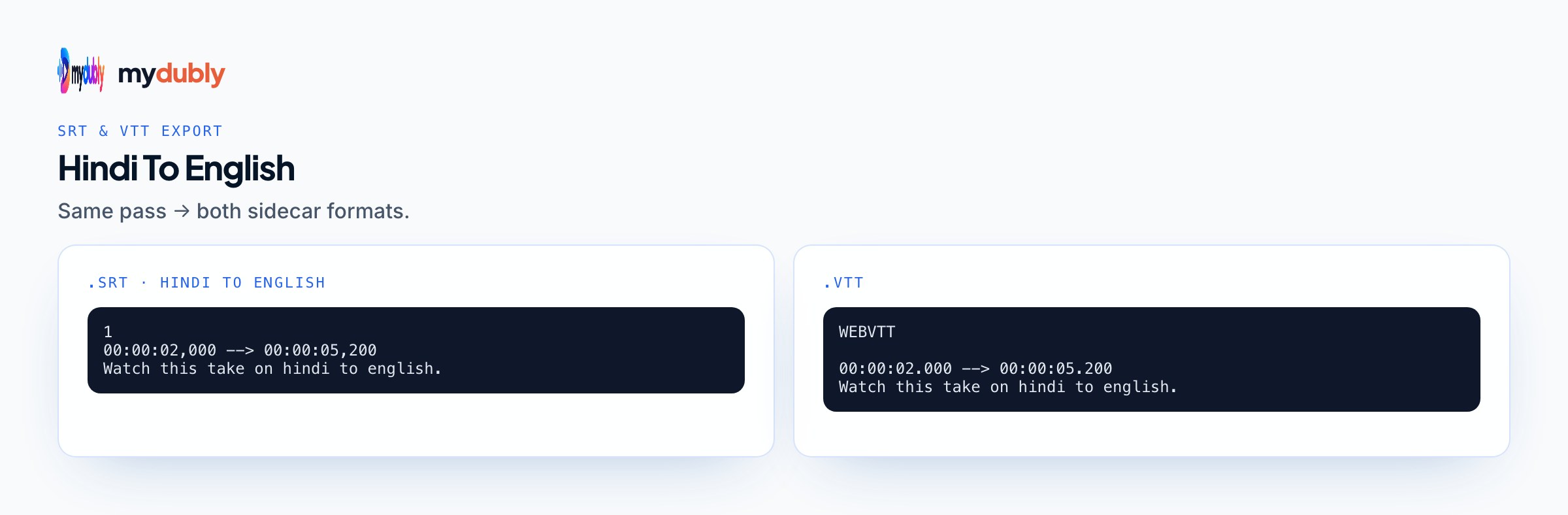
- English subtitles as SRT and VTT files.
- With Full translation output on: an English voice track in which each person (up to 8) speaks in a copy of their own voice, the translated audio as M4A, and an MP4 that keeps your original picture, music and effects.
- Hindi is detected automatically. The tool above is already set to English, so you only drop in the file.
Hindi to English at a glance
Hindi to English handles Hinglish well: English words already in the speech pass straight through. Formal Hindi lectures transcribe cleanly and translate into readable English.
Indian creators and educators use this direction to reach audiences outside India and the diaspora who prefer English. Because Hindi speech often already mixes in English terms, those words come through naturally in the English output.
Bollywood songs, background music and crowd noise reduce accuracy — for lectures and talks recorded with a microphone, results are strongest.
Hinglish in, English out
Most Hindi recorded today is mixed: a coaching lecture says "yeh formula apply karo", a vlog says "maine order cancel kar diya". The English words in such speech pass straight into the English translation, so mixed speech usually translates more smoothly than pure, formal Hindi. What needs a look is the Hindi transcript itself, where the same English word may be written in Devanagari in one line (ऑर्डर) and in Latin letters in the next. If you publish the Hindi transcript as well, make the spelling consistent; the English side is unaffected.
Brand names, app names and technical terms are the words most worth checking in the English, because a word that was misheard in the Hindi transcript arrives in the English as a different word. The article on translating mixed-language videos explains how code-switching moves through transcription and translation.
Respect words that English drops
Hindi marks respect in every sentence: aap, tum and tu are three levels of "you", and verbs change with them. English has one "you", so a student speaking politely to a teacher and two friends joking sound the same in translation. Honorifics go the same way. "Sharma ji", "bhaiya", "didi" and "sir" in a classroom usually come out as a bare name or disappear.
For a global audience that is normally fine. For viewers in the diaspora, who expect those words, add them back in the English subtitles: "Sharma-ji" or "didi" in an English line reads naturally to them and keeps the relationship visible. The SRT is plain text, so this takes a few minutes in any editor; see how to edit an SRT file.
Lakh, crore and rupees in English
A Hindi speaker says "paanch lakh" and "do crore". The English may come out as "five lakh" and "two crore", which Indian readers understand and most others don't, or as "500,000" and "20 million", which everyone can read. Decide which your audience needs and check every large figure against the Hindi transcript, because a misplaced zero in a fee, salary or price misleads viewers more than any awkward phrasing. Rupee amounts stay in rupees; add a dollar figure in the description if viewers abroad need one.
English subtitles or an English dub
English subtitles cost 5 credits per minute and suit YouTube viewers abroad, who can still hear the original speaker. A dub suits training, courses and explainers, where people want to listen while they look at the screen. In the dub each person speaks English in a copy of their own voice, taken from a short clean sample of their speech, so a teacher still sounds like the teacher. How much of the original accent carries into the English varies from voice to voice, which is why a two-minute test clip before a long series is worth it.
Indian English and international English differ in a few words ("prepone", "out of station"). The translation produces general English, so viewers anywhere can follow it.
Where Hindi to English struggles
- Songs and background music: sung lyrics are removed with the speech in the dub, and loud music under speech lowers transcript accuracy.
- Strong regional speech, such as Bhojpuri- or Haryanvi-influenced Hindi, transcribes less reliably than standard Hindi; try a short clip first.
- Crowds and crosstalk, for example in a wedding video or a live event, can put a short line in the wrong voice in the dub.
- Text on screen (slides, captions burned into the picture) stays in Hindi; only speech is translated.
Costed examples
A Delhi coaching institute translates a 22-minute Hindi physics lecture into English for students in other states.
Cost: 2,640 credits ($2.64) for the English dub, which includes the subtitles and both transcripts, or 110 credits (11¢) for English subtitles and transcripts without a voice.
A Jaipur travel vlogger turns a 12-minute Hinglish vlog into English subtitles and an English dub for subscribers in the UK and the US.
Cost: 1,440 credits ($1.44) for the English dub, which includes the subtitles and both transcripts, or 60 credits (6¢) for English subtitles and transcripts without a voice.
A family in Lucknow translates a 9-minute video message from the grandparents into English for grandchildren in Canada who don't speak Hindi.
Cost: 1,080 credits ($1.08) for the English dub, which includes the subtitles and both transcripts, or 45 credits (4.5¢) for English subtitles and transcripts without a voice.
Using the tool on this page
- The spoken language is detected automatically across about 100 languages; you can pin it, or pick one of 21 languages to translate into. Files can be up to 2 hours long.
- Only the audio is sent for processing — the video stays on your device. The finished dub opens in the dub editor, where you can correct words, timing, levels, background and subtitles and re-process only what changed. Its files are deleted 120 minutes after you last use the editor (how files are protected).
- You can download a translated video that keeps your music and effects, the translated audio as M4A, a transcript and subtitles (SRT and VTT). Every output, step and limit is explained on the video dubbing tool page.
More language pairs
See also
Frequently asked questions
Can I get only English subtitles for a Hindi video?
Yes. Switch Full translation output off and keep English selected. You get English SRT and VTT files plus the Hindi and English transcripts, at 5 credits per minute (minimum 25 credits per file).
Will the English dub still sound like the Hindi speaker?
Each person is dubbed in a copy of their own voice, taken from a short clean sample of their speech in your file, with English pronunciation. Dub a 2-minute clip first, which costs 240 credits (24¢), to hear how a particular voice comes across.
Does it understand Hinglish?
Yes. Mixed Hindi-English speech transcribes well, and English words carry straight through to the English translation.