What you get back
- An English transcript next to the original Arabic transcript, plus a timestamped version.
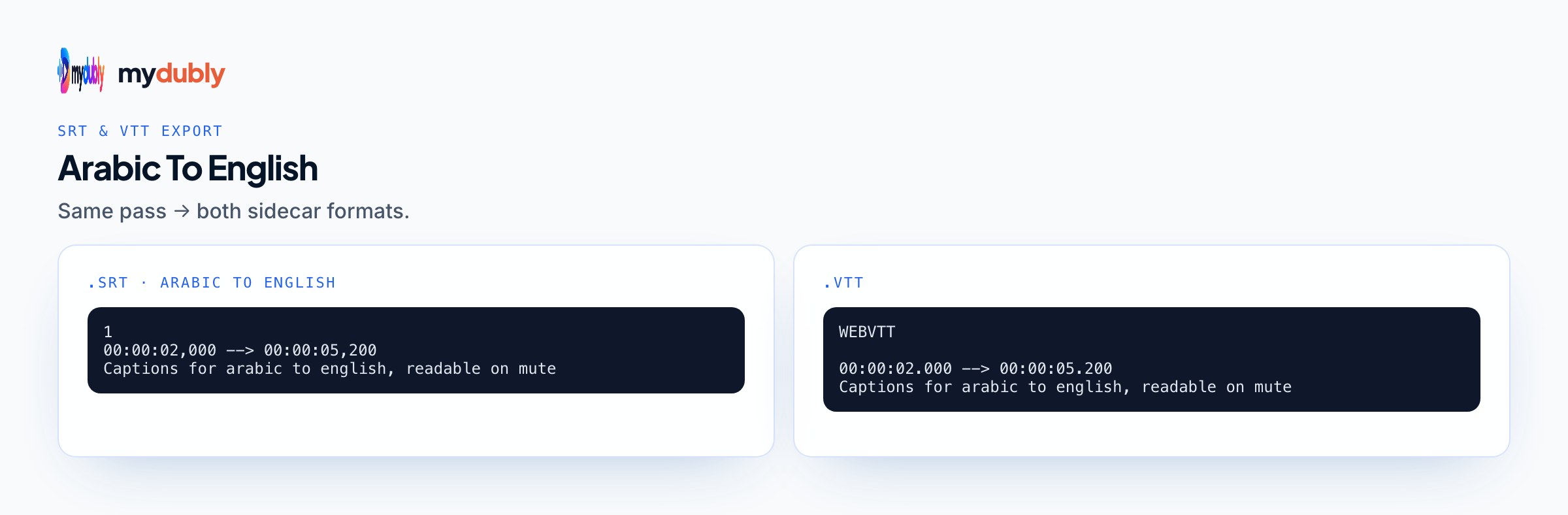
- English subtitles as SRT and VTT files.
- With Full translation output on: an English voice track in which each person (up to 8) speaks in a copy of their own voice, the translated audio as M4A, and an MP4 that keeps your original picture, music and effects.
- Arabic is detected automatically. The tool above is already set to English, so you only drop in the file.
Arabic to English at a glance
Arabic to English works best when the speaker uses Modern Standard Arabic; dialect-heavy speech is transcribed less reliably, and transcript errors carry into the translation.
Formal speech — news, lectures, sermons, official statements — is close to Modern Standard Arabic and transcribes most reliably. Everyday dialect, especially Maghrebi, is harder, and errors in the Arabic transcript carry over into the English.
Researchers, NGOs and journalists use this direction for interviews and field recordings. For published quotes, have an Arabic speaker verify the key lines.
Phrases English doesn't have
Arabic conversation is full of fixed expressions: إن شاء الله (inshallah), الحمد لله (alhamdulillah), ما شاء الله (mashallah) and greetings like السلام عليكم. A translation may render them as "God willing", "thank God" or "peace be upon you", or leave them out. For a Muslim audience or a diaspora audience, many viewers prefer the original words, transliterated, in the English subtitles. For a general business audience, the English meaning or nothing at all usually reads better. Decide which and edit the SRT to match. Fillers like يعني ("I mean") can also clutter the English; delete them from subtitles where they add nothing.
Spelling Arabic names in English
There is no single English spelling for most Arabic names: Mohammed, Muhammad and Mohamed are all common, as are Abdel and Abdul, and al- or el- before a family name. The translation picks one, and a misheard letter in the Arabic transcript can change a name altogether. Check every person, place and organisation against how they spell themselves in English; translation vs transliteration explains why names behave differently from other words.
From right to left to left to right
The Arabic transcript is written right to left; the English subtitles run left to right, which every player handles without special settings. Numbers spoken in Arabic come out in Western digits in English. In the Arabic transcript they may appear as Eastern Arabic digits (٣ for 3), so search both forms when you check figures.
Dialects and mixed speech
Formal speech close to Modern Standard Arabic transcribes most reliably. Everyday dialect is harder, and speech that mixes languages, such as Maghrebi Arabic with French or Gulf business Arabic with English, is the least predictable. The English words in mixed speech usually pass through; the French ones may not. Test a two-minute clip of the actual speakers before committing a long recording.
Sermons, lectures and religious content
Khutbahs, lectures and religious lessons are often in formal Arabic, which suits transcription. Quranic verses and hadith quoted in a talk are machine-translated freshly, so they won't match an established English translation. Replace them with the translation your community uses before publishing. The sermon translation page covers recorded services in more detail.
In a dub, each person speaks English in a copy of their own voice, up to 8 people per file. To the vocal separation, recitation is a voice like any other: it is removed from the background, and whatever the speech recognition heard is spoken in English. If the recitation itself should stay audible, English subtitles on the original video are the better format.
Costed examples
An NGO translates a 31-minute Arabic community meeting recorded in Amman into an English transcript for its donors' report.
Cost: 3,720 credits ($3.72) for the English dub, which includes the subtitles and both transcripts, or 155 credits (15.5¢) for English subtitles and transcripts without a voice.
A university in Cairo dubs a 20-minute Arabic lecture into English for its international students.
Cost: 2,400 credits ($2.40) for the English dub, which includes the subtitles and both transcripts, or 100 credits (10¢) for English subtitles and transcripts without a voice.
A Riyadh company adds English subtitles to a 10-minute Arabic address by its CEO for international staff.
Cost: 1,200 credits ($1.20) for the English dub, which includes the subtitles and both transcripts, or 50 credits (5¢) for English subtitles and transcripts without a voice.
Using the tool on this page
- The spoken language is detected automatically across about 100 languages; you can pin it, or pick one of 21 languages to translate into. Files can be up to 2 hours long.
- Only the audio is sent for processing — the video stays on your device. The finished dub opens in the dub editor, where you can correct words, timing, levels, background and subtitles and re-process only what changed. Its files are deleted 120 minutes after you last use the editor (how files are protected).
- You can download a translated video that keeps your music and effects, the translated audio as M4A, a transcript and subtitles (SRT and VTT). Every output, step and limit is explained on the video dubbing tool page.
More language pairs
Frequently asked questions
Can I upload an Arabic SRT file to translate it?
No. Subtitles are generated from the speech in your video or audio file; existing subtitle files can't be imported.
Will Quran verses match a standard English translation?
No. Quoted verses are machine-translated like any other speech. Substitute the translation your community uses in the subtitles and transcript.
Does it work with Egyptian or Gulf Arabic?
It can, but dialect speech is less reliable than Modern Standard Arabic. Try a short clip first.