What you get back
- An English transcript next to the original Russian transcript, plus a timestamped version.
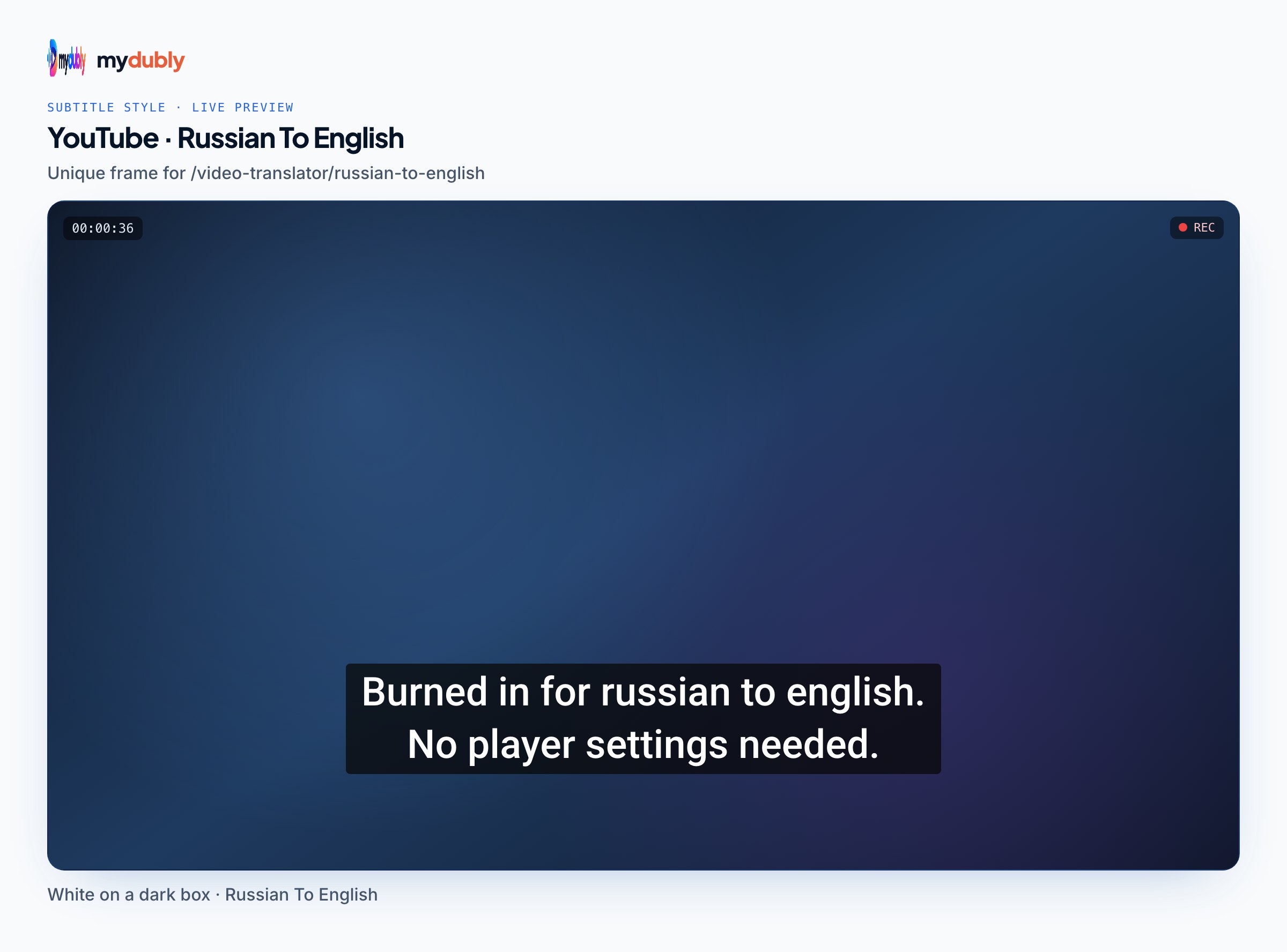
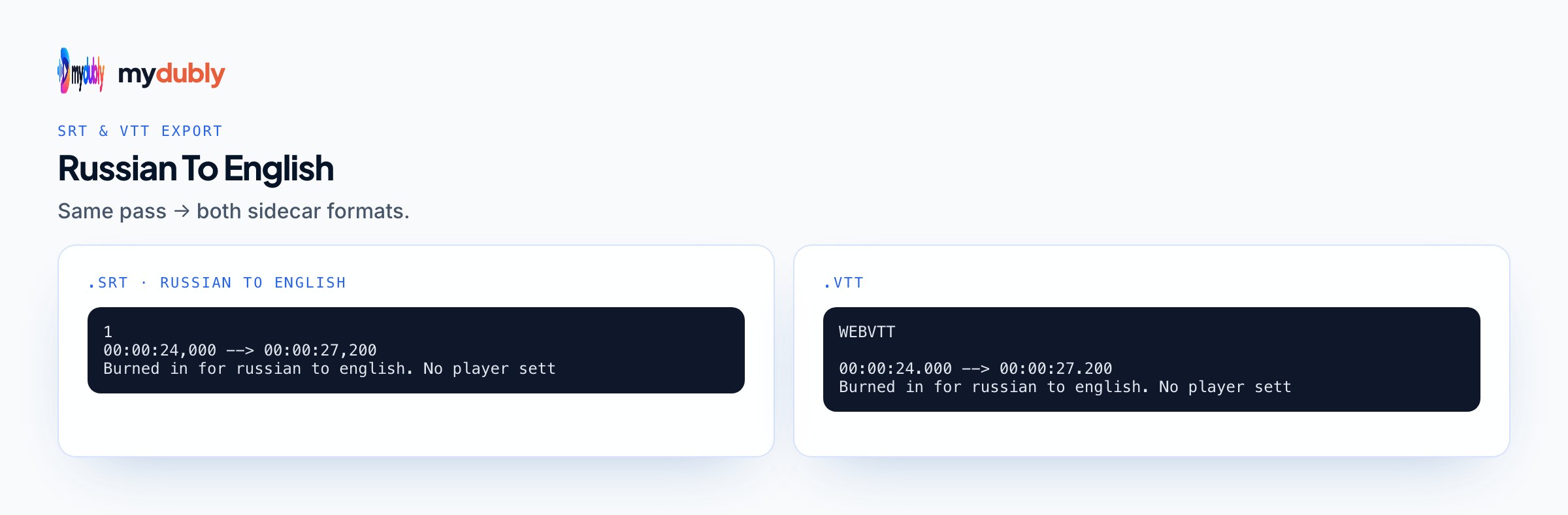
- English subtitles as SRT and VTT files.
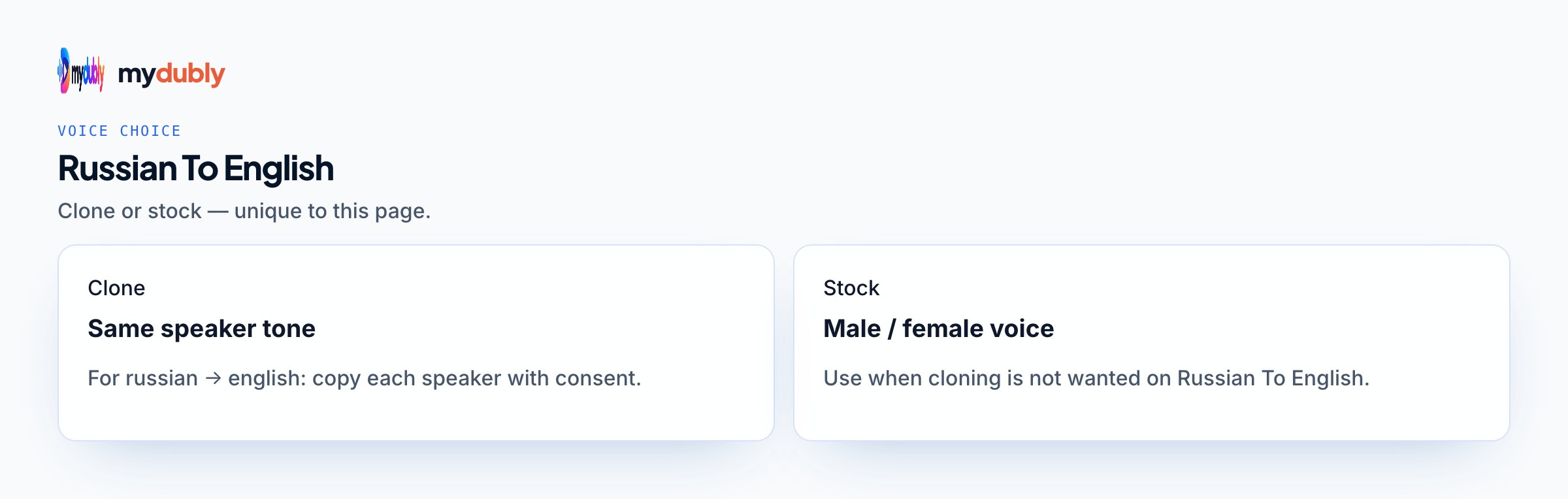
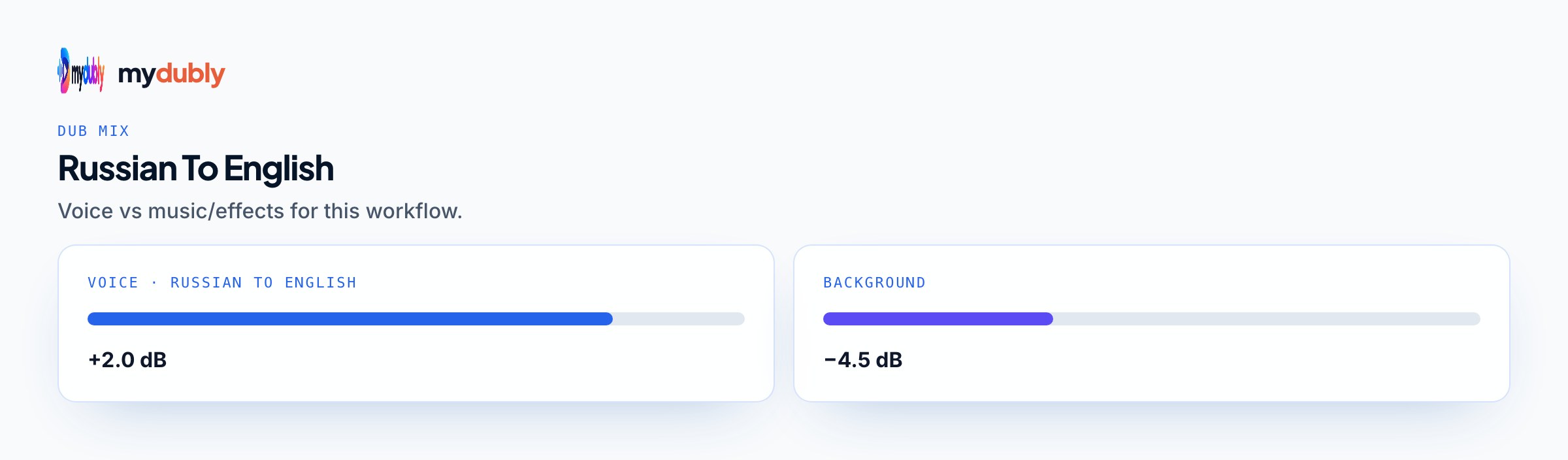
- With Full translation output on: an English voice track in which each person (up to 8) speaks in a copy of their own voice, the translated audio as M4A, and an MP4 that keeps your original picture, music and effects.
- Russian is detected automatically. The tool above is already set to English, so you only drop in the file.
Russian to English at a glance
Russian to English shortens text and removes gendered verbs. Names may be transliterated differently from your preferred spelling (Yuri or Yury), so check them.
Names, patronymics and spellings
A Russian speaker addressing a colleague politely uses first name and patronymic: "Иван Петрович", "Мария Сергеевна". English has no equivalent, so translations either keep the full form ("Ivan Petrovich"), which sounds formal and foreign, or reduce it to a first name, which sounds more familiar than the original. Diminutives multiply this: Александр can be Sasha or Shura, and Екатерина can be Katya. Viewers new to Russian may not realise these are the same person, so in subtitles you may want to use one form consistently.
Transliteration varies too. Юрий is Yuri, Yury or Iurii, depending on the system, and people who live abroad often use a spelling of their own. Check names against how each person writes them in Latin letters. Places in Ukraine, Kazakhstan and other countries have official English spellings of their own (Kyiv, Almaty), which may differ from a transliteration of the Russian form; use the spelling your audience expects. The article on translating names and technical terms has a checklist.
Ты, Вы and English "you"
Russian distinguishes ты (informal) and Вы (formal), and switching between them signals a change in relationship. English "you" covers both, so a shift from formal to informal in an interview, often meaningful, disappears in translation. Gendered past-tense verbs disappear too: "я сделала" tells you a woman is speaking, while "I did" doesn't. Neither matters for most training or technical content; in interviews and oral histories, mention such shifts in your notes.
Word order and emphasis
Russian word order is flexible, and speakers move the important word to the end of the sentence for emphasis. English fixes the order and shows emphasis in other ways, so the translation rearranges sentences and some of the speaker's emphasis is lost. Long sentences with participle chains, typical of formal Russian speech and lectures, are split or restructured in English, and that is usually where subtitle cues come out long. Split them in the SRT if they are hard to read in time.
Numbers, dates and units
Russian writes decimals with a comma (3,5) and separates thousands with a space (1 500 000). Dates come day first: 05.04 is 5 April. Translation normally converts these, but a figure misheard in the Russian transcript arrives as a confident wrong number, so compare prices, quantities and dates with the original. "Миллиард" is a billion in English; "триллион" is a trillion.
Who translates Russian video into English
- Researchers and journalists
- Interviews, archive footage and public statements, where the English transcript is the working document
- Engineering and industry
- Equipment, maintenance and process videos from plants and suppliers
- Companies with regional teams
- Town halls and training from offices across Central Asia, the Caucasus and Eastern Europe, where Russian is often the shared language
- Creators
- Russian-language channels adding English subtitles or an English dub
For interview work, translating qualitative interviews explains how to keep translated quotes accurate.
Limits for Russian sources
- Ukrainian and Belarusian can be transcribed but are not among the 21 translation targets. Speech that mixes Russian with Ukrainian (surzhyk) transcribes less reliably than standard Russian.
- Strong regional accents and fast, slang-heavy speech produce more transcript errors; try a short clip first.
- Text on screen stays in Russian; only speech is translated.
- In a dub, each person (up to 8) is voiced in a copy of their own voice; quick crosstalk can land in the wrong voice.
Costed examples
A research group in Berlin turns a 40-minute Russian interview into an English transcript and checks each quote against the Russian before publishing.
Cost: 4,800 credits ($4.80) for the English dub, which includes the subtitles and both transcripts, or 200 credits (20¢) for English subtitles and transcripts without a voice.
An engineering firm dubs an 18-minute Russian equipment-maintenance video into English for technicians at its Texas plant.
Cost: 2,160 credits ($2.16) for the English dub, which includes the subtitles and both transcripts, or 90 credits (9¢) for English subtitles and transcripts without a voice.
Using the tool on this page
- The spoken language is detected automatically across about 100 languages; you can pin it, or pick one of 21 languages to translate into. Files can be up to 2 hours long.
- Only the audio is sent for processing — the video stays on your device. The finished dub opens in the dub editor, where you can correct words, timing, levels, background and subtitles and re-process only what changed. Its files are deleted 120 minutes after you last use the editor (how files are protected).
- You can download a translated video that keeps your music and effects, the translated audio as M4A, a transcript and subtitles (SRT and VTT). Every output, step and limit is explained on the video dubbing tool page.
More language pairs
Frequently asked questions
Can it translate Ukrainian video?
Ukrainian can be transcribed, but it is not a translation/dubbing target. Speech mostly in Russian with some Ukrainian words can work, but expect more transcript errors around the mix.
How are Russian names spelled in English?
The translation transliterates them, and the system varies (Yuri, Yury). Check each name against how the person spells it in Latin letters and make the subtitles consistent.
Do I get the Russian transcript as well?
Yes. Every translation includes the original Russian transcript next to the English one, so you can check any line against what was said.