What you get back
- An English transcript next to the original Korean transcript, plus a timestamped version.
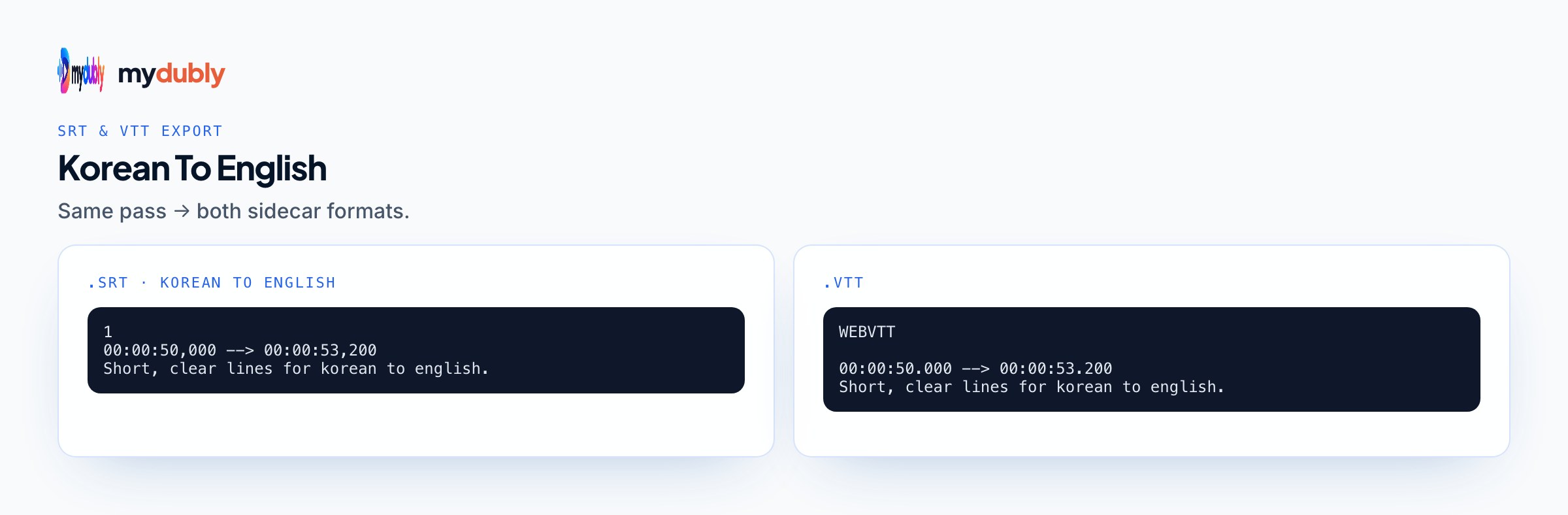
- English subtitles as SRT and VTT files.
- With Full translation output on: an English voice track in which each person (up to 8) speaks in a copy of their own voice, the translated audio as M4A, and an MP4 that keeps your original picture, music and effects.
- Korean is detected automatically. The tool above is already set to English, so you only drop in the file.
Korean to English at a glance
Korean to English reorders sentences and drops speech levels, which have no direct English equivalent. Honorific nuance is lost — usually fine for business and education.
Korean content — education, beauty, gaming and entertainment — has a huge international audience. Korean speech levels and honorifics don't map onto English, so the translation conveys meaning but flattens formality.
Korean puts the verb at the end, so long sentences are fully restructured. Subtitle cues follow the Korean speech timing, which can make some English cues feel slightly ahead of or behind the speaker's emphasis.
Speech levels and titles
Korean changes verb endings for the listener: formal -습니다, polite -요 and casual banmal. English has none of these, so a junior employee addressing the CEO and two friends joking come out in the same register. Titles go the same way. 선배 (senior), 오빠 and 언니 (older brother or sister, used far beyond family), and the suffix -님 usually become a name, "you" or nothing.
Viewers who follow Korean content in English are used to seeing "sunbae", "oppa" or "unnie" kept in subtitles, because the relationship matters to the story. If your audience is one of them, add those words back in the English SRT. For a business audience, the plain English is usually what you want.
Who "we" refers to
Korean says 우리 ("our") where English says "my": 우리 회사 is "my company" or "our company", 우리 엄마 is "my mum". Translations sometimes keep "our" where English would say "my", which sounds odd in a personal vlog. Korean also drops subjects whenever context makes them clear, so in fast conversation the English can pick the wrong "he" or "she". Interviews deserve a read-through for both.
Two ways of counting
Korean has native numbers (하나, 둘) for counting things and hours, and Sino-Korean numbers (일, 이) for money, dates and minutes. Large numbers group by 만 (10,000): 3만 원 is 30,000 won and 1억 is 100 million. Spoken numbers are where recognition errors cost the most, so check every figure against the Korean transcript. Ages need a look too. Older recordings may use "Korean age", which is one or two years higher than international age; South Korea switched official documents to international age in 2023.
Captions on screen stay in Korean
Korean vlogs and variety-style videos often have text burned into the picture: jokes, sound words and the speaker's lines in large fonts. mydubly translates speech only, so those captions stay in Korean in the dubbed MP4 and aren't part of the English subtitles. If the on-screen text carries meaning, plan to add English captions in your editor; see translating on-screen text in videos.
English dub or English subtitles
English subtitles keep the original voices, which K-content audiences often prefer. An English dub suits tutorials, training and product videos where viewers want to listen. Each person is dubbed in a copy of their own voice, up to 8 people, so a host and guest stay distinct. Korean sentences end with the verb, so the English is rearranged; subtitle cues follow the Korean speech timing, and the dub places each English line where the Korean line was spoken. The romanisation guide helps when names need a consistent English spelling.
Costed examples
A Seoul language academy translates a 14-minute Korean study-tips video into English for international learners.
Cost: 1,680 credits ($1.68) for the English dub, which includes the subtitles and both transcripts, or 70 credits (7.0¢) for English subtitles and transcripts without a voice.
A Busan cooking channel dubs a 12-minute recipe video into English and keeps the Korean original on its main channel.
Cost: 1,440 credits ($1.44) for the English dub, which includes the subtitles and both transcripts, or 60 credits (6¢) for English subtitles and transcripts without a voice.
A UX research team turns a 45-minute Korean user interview into an English transcript to share with designers in Berlin.
Cost: 5,400 credits ($5.40) for the English dub, which includes the subtitles and both transcripts, or 225 credits (22.5¢) for English subtitles and transcripts without a voice.
Using the tool on this page
- The spoken language is detected automatically across about 100 languages; you can pin it, or pick one of 21 languages to translate into. Files can be up to 2 hours long.
- Only the audio is sent for processing — the video stays on your device. The finished dub opens in the dub editor, where you can correct words, timing, levels, background and subtitles and re-process only what changed. Its files are deleted 120 minutes after you last use the editor (how files are protected).
- You can download a translated video that keeps your music and effects, the translated audio as M4A, a transcript and subtitles (SRT and VTT). Every output, step and limit is explained on the video dubbing tool page.
More language pairs
Frequently asked questions
Can it translate the Korean captions burned into my video?
No. Only speech is translated. Text that is part of the picture stays as it is, so add English captions for it in your video editor.
Will words like oppa or sunbae stay in the English?
Usually not; the translation renders them as names, "you" or plain English. Add them back in the SRT if your viewers expect them.
Are Korean names romanised correctly?
Usually, but romanisation varies (Lee/Yi, Park/Bak). Check names against how the people spell them in English.