The job this audio does
Training VO must not soften safety language. Paste scripts you own. mydubly does not lip-sync to faces or open your video file. You download speech and lay it under picture elsewhere. Style focus: Clear/Low/News—not a duplicate of course translation landings. training video voiceover AI focuses on Clear, News, Calm, or Low professional delivery for scripts already in the language you want heard. It is not a silent stand-in for course-script or slide-narration translation landings when language change is the real job. Paste module or talk-track copy, generate M4A, and place it in your LMS, deck, or NLE yourself for training video voiceover ai workflows. A practical training video voiceover ai workflow looks like this: lock a house voice (Clear, News, Calm, or Low), paste one module or talk track, generate, scrub every unit and obligation verb, then import M4A into the LMS, deck, or NLE. Document the voice id for collaborators so module five matches module one. When the job is translating lesson or slide copy into another spoken language, switch to the dedicated translation landings rather than stretching this style page. No SCORM import, no PA push, no lip-sync — speech you place yourself for training video voiceover AI.
Clear delivery without drama
Ryan Clear for step-by-step training. Uncle Fu for serious policy tone. Ryan News for factual briefings. Angry mood is wrong for most compliance calm; keep warnings firm through wording and Clear delivery. On Training Video Voiceover AI, Ryan Clear and News keep terms exact; Calm softens wellbeing modules; Uncle Fu carries grave policy tone. Quote UI labels. Avoid Energetic or Angry unless the script truly needs them. Conversation mode can split teacher and example lines. training video voiceover AI should sound instructional, not theatrical. Editors working on training video voiceover ai should keep a simple checklist: Speak in correct, voice id locked, fragile tokens isolated, M4A named with the episode or Reel date, and a note of which lines were re-spoken after legal review.
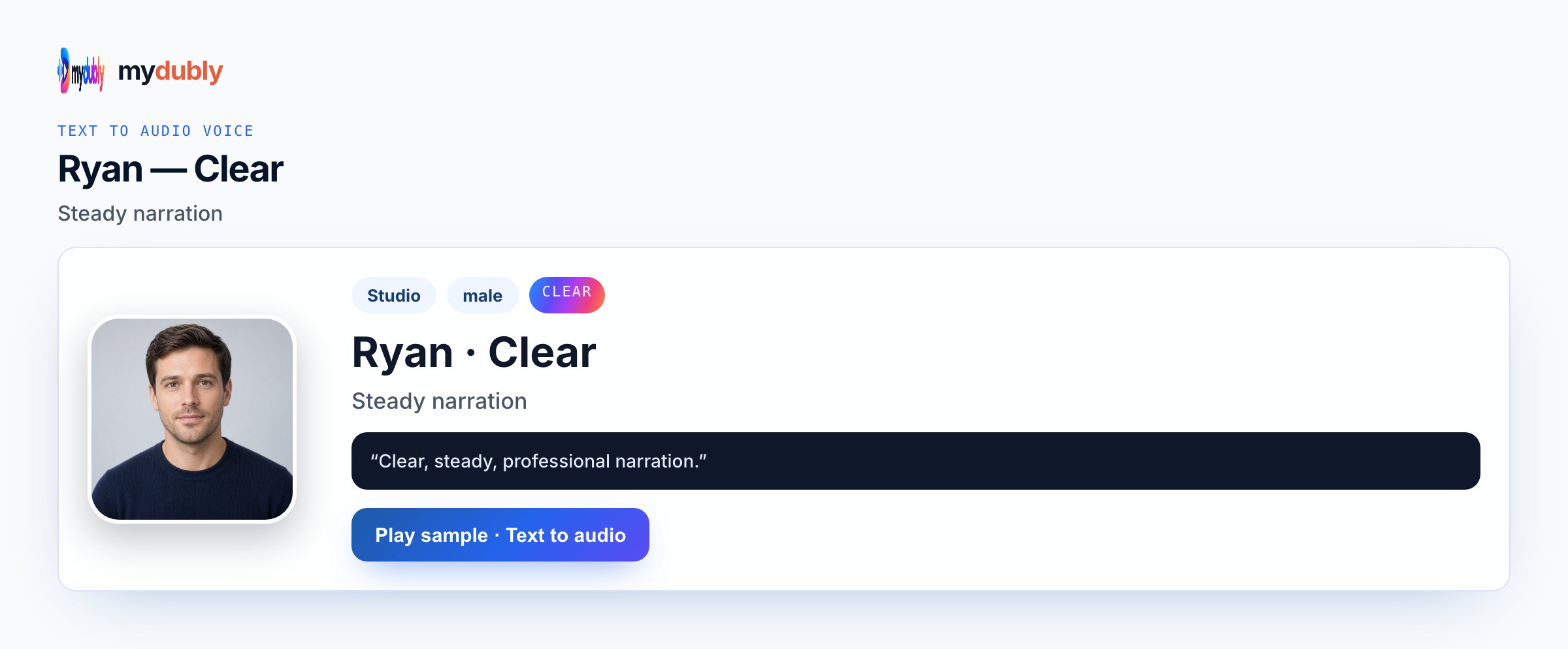
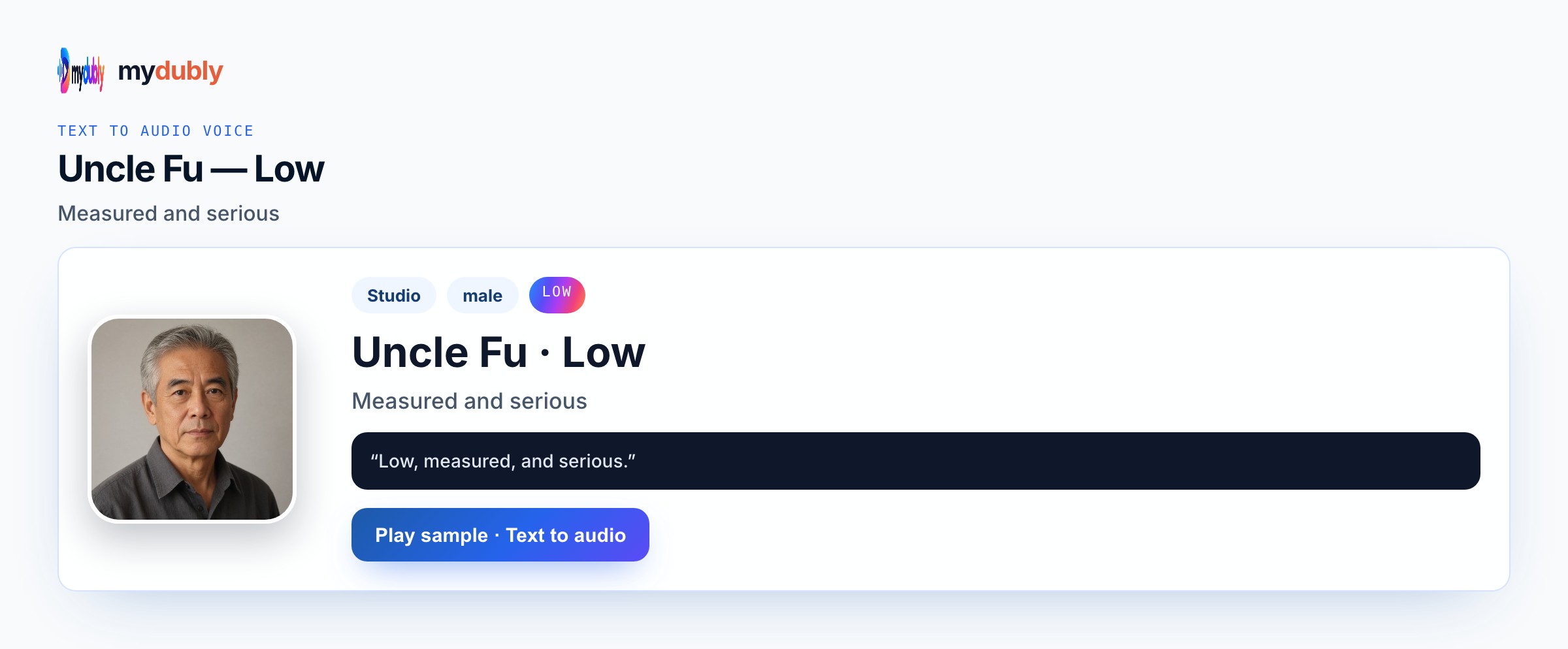
Example wording
"Never stand under a raised load." "Lock out the power before you open the panel." "Report damage before the next shift starts."
"Say the unit aloud in the script."
"Keep must and never on their own lines."
"One module paste, one cleaner retake."
Teams that ship this
Training video voiceover AI serves L&D teams recording training VO for footage they already shot. Ryan Clear fits step-by-step training; Uncle Fu serious policy tone; News factual briefings. Safety modules keep warning verbs strong. Editors download M4A for the NLE and lay speech under picture. Angry mood is wrong for most compliance calm — keep warnings firm through wording and Clear delivery. Dubbing credits; no lip-sync. Training Video Voiceover AI users who already locked picture still benefit from one M4A they can duck under B-roll, slides, or soft beds they own — Conversation mode only when a second speaker must contrast.
Produce the reading
Paste the training script, choose Clear or Low, set Speak in, and generate. Hear every warning twice. Restore any softened verb and speak the script again. Download the M4A for your NLE. Generate Training Video Voiceover AI, scrub units and obligations, re-speak bad lines, and import M4A into your authoring tool or NLE. One module or talk track per job keeps retakes sane. Do not expect SCORM import, PA push, or lip-sync. Translation-centered jobs belong on the dedicated spoken-translation pages, not this training video voiceover ai style angle.
Training audio mistakes
Expecting lip-sync to instructor video is the core false hope. Softening “never” and “must” in the paste undercuts safety. Using Bright jokes in forklift modules confuses tone. Confusing this with course translation pages is the wrong job. Music beds are not included. Splitting every warning into its own job wastes the minimum. Inventing auto music beds, lip-sync, or platform auto-post for this job will disappoint — mydubly returns spoken audio you place yourself. Skipping a headphone scrub on names, numbers, and claims forces full re-speaks later when a single editor fix would have been enough.
After you listen
Put critical warnings on their own lines. Avoid jokes in safety modules. Clone a certified trainer only with a quiet sample and permission. For training VO, put never and must warnings on their own lines, avoid joke energy in safety modules, and lay the M4A under picture yourself — there is no lip-sync. When you publish training video voiceover AI audio, credit rules and acceptable-use still apply: original wording or cleared rights, no celebrity impersonation packs, and no claim that mydubly supplied music or lip-sync it did not generate.
Using the tool on this page
- Paste the text. The language it is written in is read from the words. Set the language it should be spoken in. The same language speaks the words as written.
- Studio and Mood voices play a short sample in Chinese, English, French, German, Italian, Japanese, Korean, Portuguese, Russian and Spanish. Hindi, Arabic, Turkish, Polish, Dutch, Swedish, Norwegian, Finnish and Hebrew need a recording of 3 to 15 seconds from someone you have permission to copy. A longer sample keeps the first 12 seconds.
- The reading is priced like a video dub: 120 credits per minute (12¢), minimum 2 minutes per file. A short paragraph still meets the 2-minute minimum.
- When it finishes, the reading stays on this page. Edit the script and speak it again: that is a new reading of the whole script at the same dubbing price, including the 2-minute minimum. Download the audio. Files stay 120 minutes. A video dub is a different job and opens in the dub editor. More is on the text to audio dubbing tool page.
Frequently asked questions
Does training voiceover sync lips to my instructor video?
No. Text to audio returns speech only. There is no lip-sync.
Where do I open training video voiceover ai?
On this page, or from the Text to Audio tab on the mydubly home page. The finished job opens in the text editor so you can change a line or a voice and speak the script again.
What file do I get from Training Video Voiceover AI?
An M4A speech file under dubbing credits, including the two-minute minimum on short pastes. Picture, music, captions, and posting stay in your own tools.