A simple definition
A transcript captures speech as text, in the order it was spoken. It may also include who said each part, when it was said and non-speech events like laughter. (The word also means an official record of a student's grades; this article is about transcripts of recordings.)
Types of transcripts
- Verbatim
- Every word as spoken, including fillers ("um", "you know"), false starts and repetitions. Used in legal work and some research.
- Clean verbatim
- The words spoken, minus fillers and false starts. Easier to read while staying faithful. The usual default.
- Edited
- Cleaned further into readable prose: grammar fixed, repetition cut. Used for articles and publications.
- Timestamped
- Any of the above with times marked, per line or at intervals, so you can find each passage in the recording.
Verbatim vs clean verbatim transcription goes deeper into the first two.
What a transcript includes and leaves out
A transcript can include:
- The spoken words.
- Speaker names or labels, such as "Interviewer" and "Participant 3".
- Timestamps.
- Notes like [laughter], [crosstalk] or [inaudible].
It leaves out what can't be written as words: tone of voice, facial expressions, what's on screen. A transcript of a video tutorial won't show the clicks; that's why descriptive transcripts for accessibility add descriptions of visual content.
Transcript vs subtitles vs minutes
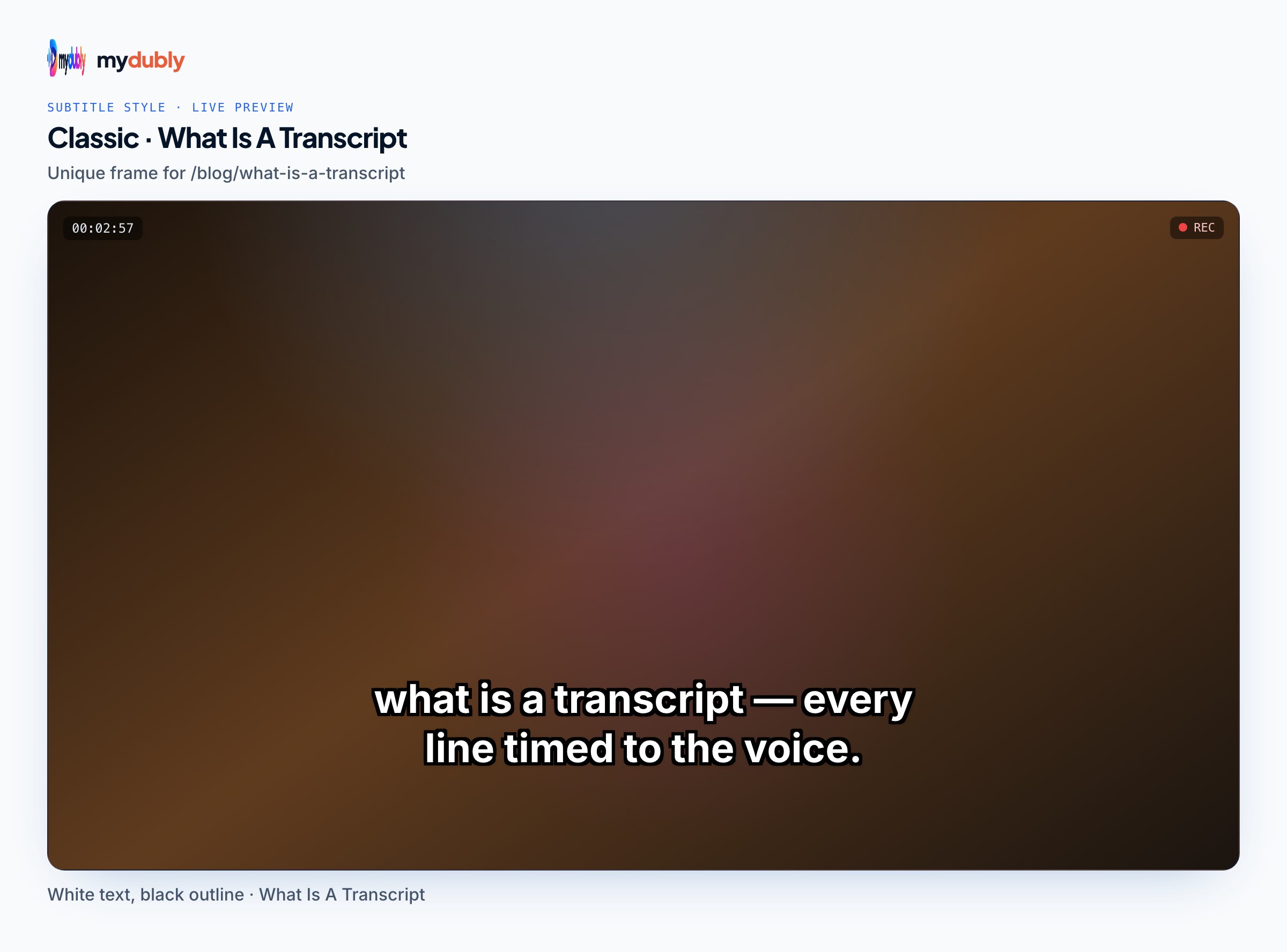
- Subtitles hold the same words split into short timed cues that appear on screen with the video. Transcript vs subtitles explains the differences in detail.
- Minutes are a summary of a meeting: decisions, actions and key points, not every word.
- A translation is the transcript's content in another language.
How transcripts are made
There are three ways to make one:
- By hand: a person listens and types. An hour of clear audio can take several hours to transcribe by hand.
- By a human service: professional transcribers, paid per minute, often with quality guarantees.
- By speech recognition: software converts speech to text in minutes. Accuracy on clear recordings is high and improving; names, accents and noise still need checking.
Many workflows combine methods: an automatic first draft, then a person proofreads. AI vs human transcription compares them.
A researcher records a 50-minute interview. For her analysis, she needs a timestamped clean verbatim transcript, so she can cite exact passages with times. For a quote in her paper, she checks the exact words, fillers included, against the recording. For a public summary, she turns sections into edited prose. All three start from the same automatic transcript, made in a few minutes.
What transcripts are used for
- Accessibility: deaf and hard-of-hearing people can read what was said.
- Search: finding a quote in an hour of audio takes seconds in text.
- Research: qualitative researchers code and analyse transcripts.
- Content: transcripts become blog posts, show notes and social posts; turning a video into a blog post shows how.
- Records: meetings, interviews and lectures kept for reference.
- Translation: a transcript is the starting point for subtitles and dubbing in other languages.
What a good transcript looks like
Whatever the type, a usable transcript has a few things in common. Paragraphs break where the speaker changes or the topic shifts, so the page isn't a wall of text. Names and terms are spelled consistently throughout. Numbers follow one convention. Unclear passages are marked rather than guessed, so readers know where to check the recording. And the file says what it is: the recording's title, date and, for interviews, who took part. How to format a transcript covers layout conventions, and for interview research the interview transcription page covers formats that suit coding and analysis. A transcript meant for publishing on a website also benefits from headings, which turn a long conversation into something readers can skim.
How to get a transcript with mydubly
Upload a video to video to text or an audio file to audio to text. Videos stay on your device; only the audio is sent over HTTPS and deleted within 30 minutes of delivery. You get:
- A plain transcript.
- A timestamped transcript.
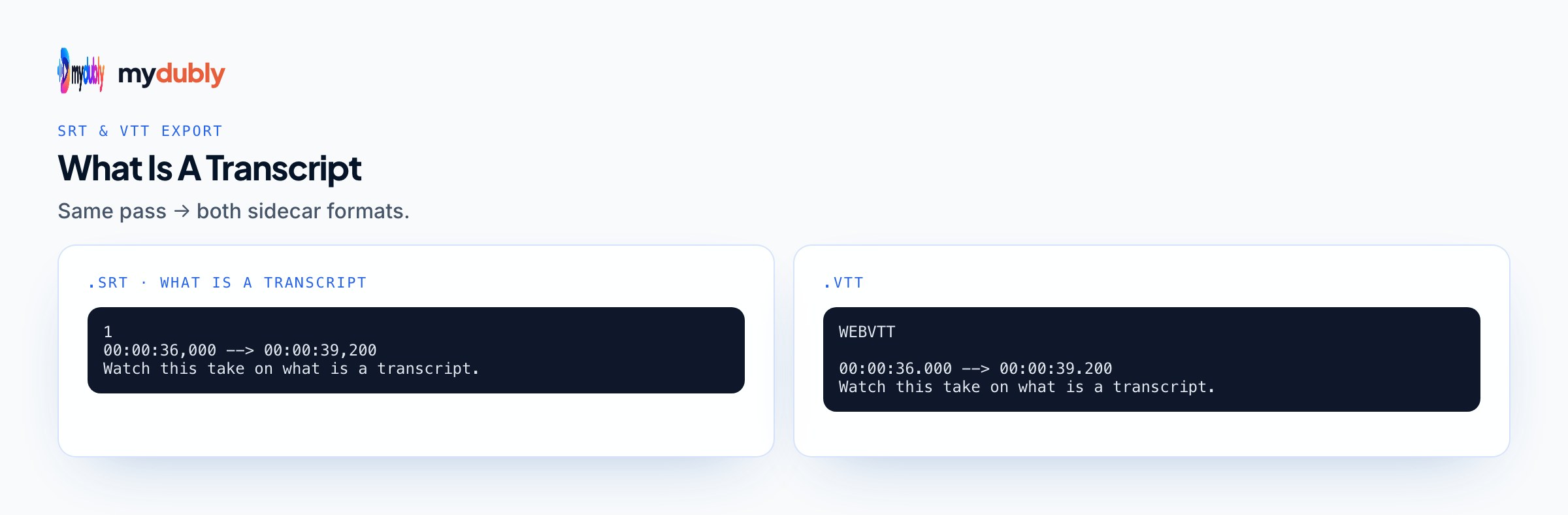
- SRT and VTT subtitle files.
- Optionally, the same in another of 21 languages.
It costs 5 credits per minute (a tenth of a cent), with a 25-credit minimum and 240 free credits for new accounts. Files can be up to 2 hours.
Limits of automatic transcripts
- mydubly transcripts don't label speakers; add names while proofreading.
- Non-speech notes like [laughter] aren't included.
- Names, technical terms and numbers deserve a check; how to proofread an AI transcript gives a fast method.
- Very noisy or overlapping speech lowers accuracy for every method.
Frequently asked questions
What is a transcript of a recording?
A written record of the words spoken in audio or video, in the order they were spoken, sometimes with speaker names and timestamps.
What are the main types of transcripts?
Verbatim (every word and filler), clean verbatim (fillers removed), edited (polished prose) and timestamped (any of these with times).
What's the difference between a transcript and subtitles?
A transcript is continuous text. Subtitles split the same words into short timed cues shown on screen with the video.
Is a transcript the same as meeting minutes?
No. Minutes summarise decisions and actions; a transcript records what was said.
How long does it take to make a transcript?
By hand, several hours per hour of audio. With speech recognition, a few minutes, plus time to proofread.
How much does a transcript cost with mydubly?
5 credits per minute, so a one-hour recording costs 300 credits (30¢).
Can I get a transcript in a different language from the recording?
Yes. That's a translated transcript: the speech is transcribed and then translated. With mydubly, choose one of 21 target languages and the translated transcript and subtitles come from the same run at no extra cost.